When to Repair vs Replace Your Heating System: A Melbourne Homeowner's Guide
Quick answer: As a general guide, repairing makes sense when your system is under about 10 years old, the fault is isolated, and the repair costs a small fraction of replacement. Replacement becomes the smarter decision when the system is near the end of its service life, repairs are becoming frequent, parts are hard to source, or running costs have climbed well above what a modern system would use. The sections below walk through how to weigh it up for your home.
When your heating plays up in the middle of a Melbourne winter, the instinct is to get it fixed as fast as possible and move on. That's the right call for many faults. But for an ageing system, the cheapest fix today can be the most expensive decision over the next few years — a series of repairs that never quite solve the problem, on a system that was always going to need replacing.
This guide gives you a clear way to decide, before you're forced into a rushed choice on the coldest night of the year.
The five questions that decide it
1. How old is the system?
Age is the single most important factor. As a general guide, ducted gas and reverse cycle systems are engineered to deliver reliable performance for roughly 10 to 15 years, with well-built premium systems often lasting longer when properly maintained. A fault on a system under 10 years old usually points towards repair. A fault on a system pushing 15 years or beyond is a signal to seriously consider replacement — even if this particular repair is straightforward.
2. How serious — and how frequent — are the faults?
A one-off fault on an otherwise reliable system is a repair. A pattern of faults is a message. If you've called for service two or three times in recent seasons, you're no longer maintaining a system — you're subsidising it. Frequent breakdowns rarely get cheaper, and they tend to cluster as a system nears the end of its life.
3. What does the repair cost relative to replacement?
A useful rule of thumb: if a single repair costs more than around half the price of a new system, replacement is usually the better long-term decision. A modest repair on a younger system is easy to justify. A major repair — a failed heat exchanger, a compressor, a control board — on an older system rarely is.
4. What is the system costing you to run?
Heating technology has moved on considerably. An older system can be quietly consuming far more energy than a modern equivalent to deliver the same warmth — a cost you carry every day it runs, on top of any repairs. If your running costs have climbed beyond what the weather explains, an efficient new system can offset part of its own cost over time.
5. Can the parts still be sourced?
Older and discontinued systems eventually reach a point where parts become difficult or slow to obtain. A system you can't get parts for is a system you can't rely on through winter — and that alone can tip the decision towards replacement, regardless of the current fault.
Repair vs replace: a decision framework
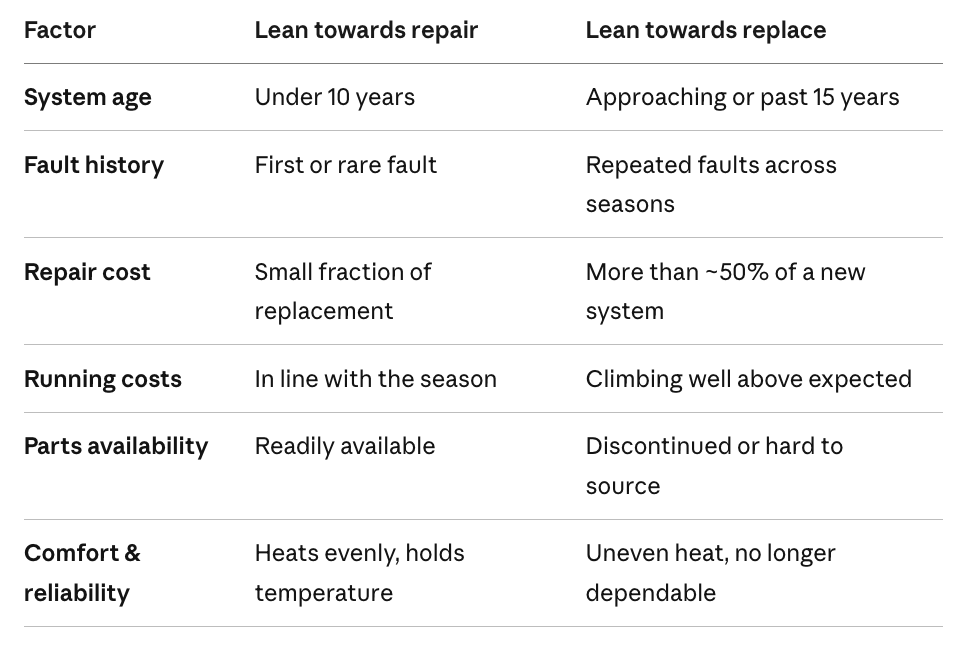
If your situation sits mostly in the left column, a quality repair is the sound choice. If it's drifting into the right column — especially on age, fault history and running costs together — replacement is usually the decision that costs you less over the years ahead.
Why "just keep fixing it" can be the expensive option
The repair-versus-replace question is really a question about time. A single repair always looks cheaper than a new system in the moment. But on an ageing system, that repair often buys you a season — not a solution. The next fault arrives, then the one after that, each one urgent, each one mid-winter, each one on a system that's still inefficient between breakdowns.
Replacing a system that's genuinely at the end of its life isn't an expense you're choosing to bring forward — it's one you're choosing to stop paying repeatedly. A modern, well-engineered system delivers reliable, even heat, lower running costs, and the simple peace of mind of not wondering whether your heating will make it through the next cold snap.
How to make the call with confidence
The honest answer is that no online guide can make this decision for your specific system — and you should be wary of anyone who gives you a definitive repair-or-replace verdict without assessing it. What a proper assessment gives you is the full picture: the real condition of your system, the likely cost and lifespan of repairing it, and a clear-eyed comparison against replacing it. From there, the right choice is usually obvious.
At First Choice Heating & Cooling, we assess your system on its merits and tell you straight — because the goal isn't to sell you a new system or talk you out of one. It's to make sure that whatever you spend, you spend once and spend well.
Frequently asked questions
How long should a heating system last in Melbourne? As a general guide, ducted gas and reverse cycle systems deliver reliable service for around 10 to 15 years. Premium, well-engineered systems that are serviced regularly often last longer. Lifespan depends heavily on the quality of the original system and how well it's been maintained.
Is it worth repairing a heating system over 15 years old? Sometimes — if the fault is minor, parts are available, and the system has otherwise been reliable. But on a system that age, it's worth getting a replacement assessment at the same time, because a major repair rarely makes financial sense and further faults are increasingly likely.
How do I know if my heater is inefficient? The clearest signs are rising energy bills that outpace the weather, longer run times to reach temperature, uneven heating across rooms, and frequent cycling on and off. A service can confirm how efficiently your system is actually running.
Should I repair now and replace later? For some systems this is a sensible bridge — a small repair to get through winter, with a planned replacement before next season. The key is to make it a deliberate plan rather than a string of reactive repairs. A proper assessment will tell you whether bridging is worthwhile or simply delaying the inevitable.
Not sure whether to repair or replace? Book an assessment with First Choice Heating & Cooling. We'll give you the full picture on your system's condition, cost and lifespan — so you can make the call once, and make it right.